Global City Connect (GCC) | national city hub demand survey Participate in Survey
GCC and Qingdao Topscomm Explore New Opportunities for China-Africa Smart Energy Cooperation
GCC and Qingdao Topscomm explored China-Africa cooperation in smart energy, digital infrastructure, and renewable technologies, aiming to help Chinese enterprises expand sustainably into African markets through global partnerships and localized support.
5/13/20262 min read
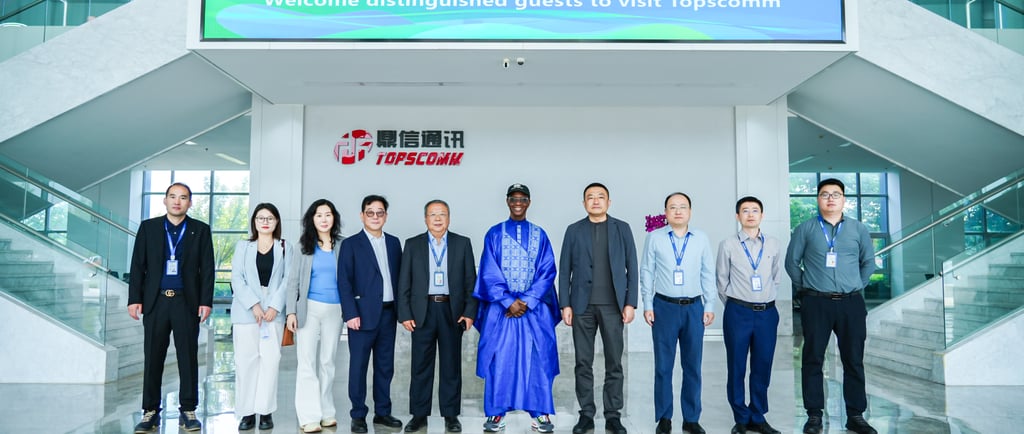
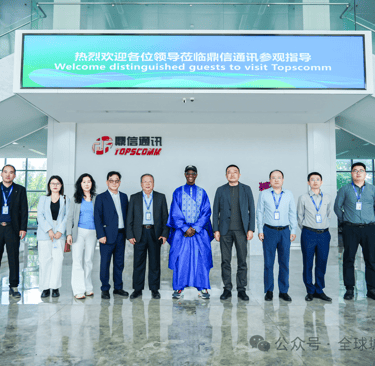
On May 11, Dr. Djibril Diallo, Chairman of GCC Africa City Hubs and former spokesperson for the President of the United Nations General Assembly, together with Martin Wang, Founder and Executive President of Global City Connect (GCC), and GCC Secretary-General Queenie Qiao, visited Qingdao Topscomm Communication Co., Ltd. for in-depth discussions on China-Africa industrial cooperation, smart energy development, and overseas market expansion.
The GCC delegation was welcomed by Topscomm Chairman Liu Min, General Manager Zeng Fanyi, and the company’s senior management team.
During the visit, the delegation toured Topscomm’s automated production facilities, intelligent manufacturing systems, and CNAS-accredited national laboratory, gaining insight into the company’s advanced capabilities in smart grid technologies, power communication systems, semiconductor and chip development, intelligent power distribution, and renewable energy support systems.
As a leading enterprise in China’s smart grid and power communication sector, Topscomm has built a complete industrial chain covering chip research and development, software and hardware engineering, PCBA manufacturing, and intelligent equipment production. The company has independently developed more than 60 proprietary “China Chips,” with over 550 million units deployed globally, while maintaining internationally recognized quality testing and certification systems.
During discussions, Liu Min emphasized that both sides could begin cooperation through mature product trade and scalable market solutions to accelerate entry into African markets.
General Manager Zeng Fanyi introduced Topscomm’s integrated smart energy ecosystem, including intelligent power distribution systems, smart metering technologies, energy terminals, smart fire safety systems, intelligent water management solutions, and renewable energy support services. He noted that the company already operates mature international cooperation models in markets including Saudi Arabia, Türkiye, South Africa, and Malaysia, which could be efficiently replicated in Africa.
Dr. Djibril Diallo noted that Africa is rapidly advancing energy digitalization and infrastructure modernization, creating strong demand for smart grids, renewable energy technologies, and intelligent power systems. He emphasized that Chinese enterprises possess significant advantages in technology, manufacturing capabilities, industrial integration, and cost efficiency.
Dr. Diallo stated that GCC will leverage its United Nations cooperation networks and global City Hub system to help Chinese enterprises strengthen international communication, build local partnerships, and expand into African markets.
Martin Wang highlighted that many Chinese enterprises still face challenges entering Africa, including limited local resources, market access barriers, and insufficient risk management capabilities. He explained that GCC aims to support companies through policy consulting, international resource matchmaking, certification assistance, local operational support, and compliance and risk management services.
Queenie Qiao introduced GCC’s growing international City Hub network, which already includes hubs and cooperation platforms in the United States, Canada, Vietnam, Japan, Pakistan, and across the African continent. She noted that GCC will continue leveraging its global network to help companies such as Topscomm establish direct communication channels with African energy authorities, utility companies, and local partners.
The visit represents another important step in GCC’s efforts to promote practical China-Africa industrial cooperation. Moving forward, GCC plans to continue working with leading Chinese manufacturing and technology enterprises to support cooperation in smart energy, digital economy, renewable energy, infrastructure modernization, and industrial localization.
Through practical collaboration and global resource integration, GCC aims to help more Chinese enterprises safely and sustainably expand into African markets while contributing to Africa’s long-term energy transformation and industrial development.