Global City Connect (GCC) | national city hub demand survey Participate in Survey

Global City Connect Joins China–Africa Cooperation Meeting
A high-level meeting brought together global political and business leaders to explore China–Africa cooperation, market opportunities, and strategies for Chinese enterprises going global.
3/20/20263 min read
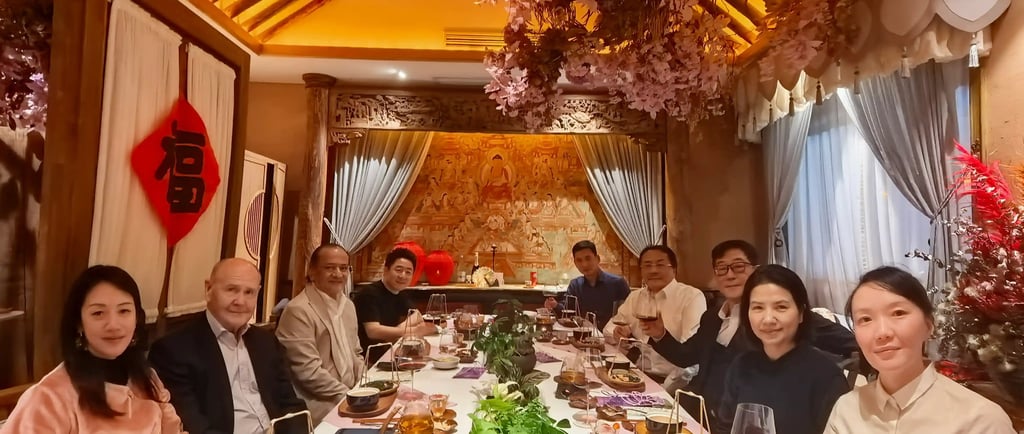
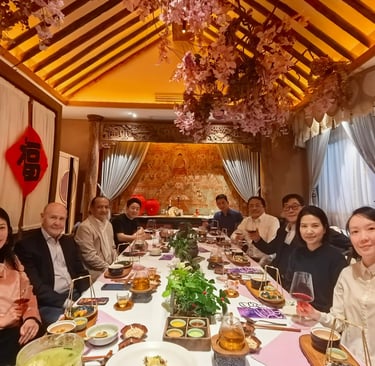
Against the significant backdrop of the 70th anniversary of diplomatic relations between China and Africa, as well as China’s implementation of zero-tariff treatment for 53 African countries with diplomatic ties, Mr. Martin Wang, Executive Vice President of the Global City Connect Alliance, was invited to attend a high-level working dinner on the evening of March 16. The dinner was hosted by Mr. Fang Jingdong, a seasoned business leader deeply engaged in the African market.
The gathering brought together prominent figures from government, international business, and industry. Participants engaged in in-depth discussions on key topics including Chinese enterprises going global, emerging opportunities in African markets, and the upgrading of China–Africa cooperation, reaching broad consensus on future collaboration.
The event featured a distinguished lineup of guests representing both authority and professional expertise. Among them were Mr. Saif Durbar, Minister and Special Advisor to the President of the Central African Republic; Sir John Peace, Chairman of A&S Resources and former Chairman of Burberry Group and Standard Chartered Bank; Dr. Peter Zhang, Executive Vice President of A&S Resources; and Ms. Natalie Rong, Deputy General Manager for China. Also present were Ms. Shi Si, Vice President of DAS SOLAR, along with her assistant Ms. Hou Ying, and Mr. Yang Bo, a business partner of Mr. Fang Jingdong, among other industry leaders. The event created a dynamic atmosphere of cross-sector dialogue and collaboration.
During the discussions, “Africa’s opportunities” emerged as the central theme. Participants unanimously agreed that Africa is currently entering a golden phase of accelerated development. With its abundant natural resources, youthful population, and rapidly advancing urbanization, the continent is gradually unlocking enormous growth potential and is poised to become a new engine of global economic growth.
Particularly in areas such as energy transition, infrastructure development, industrial investment, and urban development, Africa’s needs align closely with the strengths of Chinese enterprises. The zero-tariff policy further amplifies this synergy, creating a powerful two-way enabling effect and laying a solid foundation for deeper China–Africa cooperation.
At the same time, participants candidly acknowledged the challenges faced by Chinese enterprises entering the African market. Despite its vast potential, issues such as information asymmetry, unstable matchmaking channels, and difficulties in risk assessment remain major bottlenecks hindering project implementation and international expansion. These challenges reflect common obstacles encountered by Chinese companies operating in Africa.
Addressing these pain points, Mr. Wang introduced the innovative “platform + mechanism” approach developed by Global City Connect. As a clearly positioned “international cooperation service hub,” GCC is actively building a global network, an outbound enterprise database, and a project matching and facilitation mechanism.
This approach aims to transform cooperation from relationship-based connections to systematic matching, and from isolated projects to long-term, sustainable collaboration systems. It is aligned with GCC’s broader service framework, which includes precise matching between cities and industries, as well as providing real-world implementation scenarios.
Participants reached a strong consensus that, amid profound changes in the global landscape, the essence of international cooperation has shifted. It is no longer about isolated project breakthroughs, but about building continuously operating cooperation mechanisms. Only by integrating global resources through platform-based and mechanism-driven approaches, removing bottlenecks, and improving efficiency, can true mutual benefit be achieved and China–Africa cooperation sustained over the long term.
The working dinner not only strengthened connections among international political and business leaders, but also deepened mutual understanding and trust. It effectively aligned key needs in China–Africa cooperation and laid a solid foundation for future collaboration in areas such as resource cooperation, industrial investment, and project implementation.
Today, Chinese enterprises are transitioning from “individual actions” to “systematic collaboration.” How to connect fragmented resources and improve matching efficiency has become a critical issue in the new era of international cooperation.
As an important bridge for global collaboration, Global City Connect will continue to leverage its network advantages and service capabilities to explore efficient and sustainable cooperation models, supporting Chinese enterprises in going global and promoting higher-quality development in China–Africa cooperation at a new historical starting point.
Together, a new blueprint for win-win China–Africa development is being drawn.